May 15, 2026
Recent Computational Techniques in De Novo Drug Design
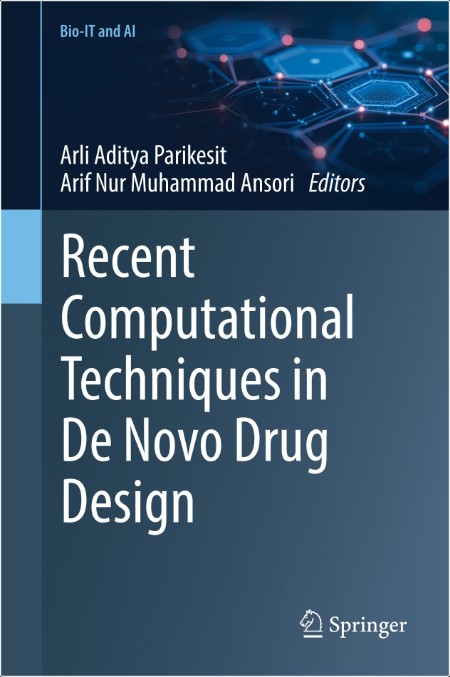
Recent Computational Techniques in De Novo Drug Design | 13.18 MB
Title: Recent Computational Techniques in De Novo Drug Design
Author: Arli Aditya Parikesit · Arif Nur Muhammad Ansori
Category: Nonfiction, Science & Nature, Science, Chemistry, Physical & Theoretical, Computers, Advanced Computing, Artificial Intelligence, Health & Well Being, Medical
Language: English | 347 Pages | ISBN: 9819913152
Description:
“Recent Computational Techniques in De Novo Drug Design” gives a thorough overview of modern computational methods used to discover new chemical compounds. The book looks at how fragment-based design, evolutionary algorithms, free-energy-guided optimization, and deep generative models have helped advance molecular discovery. It also discusses important challenges such as synthetic accessibility and ADME/Tox issues. The book explains how structural bioinformatics, cheminformatics, and machine learning work together to speed up hit generation and lead optimization in both academic and industry settings.
The chapters start by introducing the basics of de novo drug design and explain how it differs from virtual screening and QSAR methods. The book describes the shift from rule-based techniques to those driven by artificial intelligence that use a wide range of molecular data. The content is organized into sections on structure-based and ligand-based methods, MD and QM approaches, deep learning applications, and case studies from different therapeutic areas.
“Recent Computational Techniques in De Novo Drug Design” gives a thorough overview of modern computational methods used to discover new chemical compounds. The book looks at how fragment-based design, evolutionary algorithms, free-energy-guided optimization, and deep generative models have helped advance molecular discovery. It also discusses important challenges such as synthetic accessibility and ADME/Tox issues. The book explains how structural bioinformatics, cheminformatics, and machine learning work together to speed up hit generation and lead optimization in both academic and industry settings.
The chapters start by introducing the basics of de novo drug design and explain how it differs from virtual screening and QSAR methods. The book describes the shift from rule-based techniques to those driven by artificial intelligence that use a wide range of molecular data. The content is organized into sections on structure-based and ligand-based methods, MD and QM approaches, deep learning applications, and case studies from different therapeutic areas.
DOWNLOAD: