May 29, 2026
Flexible Nanoelectronics Electrical – Mechanical Behavior in Graphene Conductive Inks
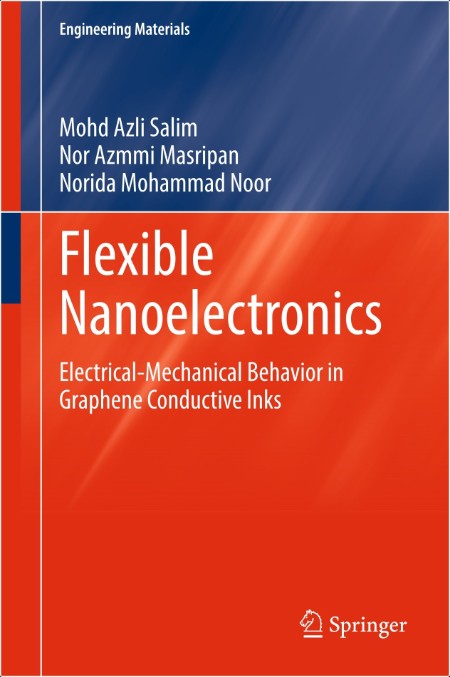
Flexible Nanoelectronics ElectricaMechanical Behavior in Graphene Conductive Inks | 12.12 MB
Title: Flexible Nanoelectronics
Author: Mohd Azli Salim · Nor Azmmi Masripan · Norida Mohammad Noor
Category: Nonfiction, Science & Nature, Science, Other Sciences, Nanostructures, Physics, Solid State Physics, Chemistry, General Chemistry
Language: English | 290 Pages | ISBN: 9789819557080
Description:
This book highlights the electrical, mechanical, and material characteristics of graphene nanoplatelet (GNP) and carbon black (CB) nanocomposite conductive inks, developed for wearable electronics. These inks were printed on flexible substrates using four distinct patterns-straight, curved, square, and zigzag-and tested under cyclic bending, tensile, and torsional stress to simulate real-world wear and movement. An optimized ink formulation is introduced, reducing nanoparticle content to 20 wt.% GNP and 25 wt.% CB without compromising performance. This improved blend demonstrates enhanced conductivity and mechanical integrity. Among the tested patterns, the curved configuration consistently yielded the lowest resistivity and highest reliability, showcasing superior adaptability under deformation. While GNP-based inks revealed higher hardness and elastic modulus, they also exhibited increased brittleness, with failure occurring before 10,000 loading cycles. The study emphasizes the critical balance between durability and flexibility in the design of nanomaterial-based conductive inks. These findings offer valuable insights for advancing flexible, wearable electronic devices by tailoring material formulations and structural designs to meet specific application demands.
This book highlights the electrical, mechanical, and material characteristics of graphene nanoplatelet (GNP) and carbon black (CB) nanocomposite conductive inks, developed for wearable electronics. These inks were printed on flexible substrates using four distinct patterns-straight, curved, square, and zigzag-and tested under cyclic bending, tensile, and torsional stress to simulate real-world wear and movement. An optimized ink formulation is introduced, reducing nanoparticle content to 20 wt.% GNP and 25 wt.% CB without compromising performance. This improved blend demonstrates enhanced conductivity and mechanical integrity. Among the tested patterns, the curved configuration consistently yielded the lowest resistivity and highest reliability, showcasing superior adaptability under deformation. While GNP-based inks revealed higher hardness and elastic modulus, they also exhibited increased brittleness, with failure occurring before 10,000 loading cycles. The study emphasizes the critical balance between durability and flexibility in the design of nanomaterial-based conductive inks. These findings offer valuable insights for advancing flexible, wearable electronic devices by tailoring material formulations and structural designs to meet specific application demands.
DOWNLOAD: